I was a whiz at the five-paragraph essay in my day. It made so much sense.
Paragraph one: tell them what you’re going to tell them
Paragraphs two thru four: tell them
Paragraph five: tell them what you told them
At least that’s how it was explained to us by Mr. Mountain, the honors English teacher who let us play Trivial Pursuit on Fridays.
I could knock out an A+ five-paragraph essay after 48 hours with no sleep and WAY too much alcohol (I proved that fact in college composition class more often than I’d care to admit).
But here’s the thing about five-paragraph essays: That’s not how to write fiction, or anything anymore (unless you’re in fourth grade and taking a standardized test).

Having written so many of them, it’s hard to break the habit. Whenever I sit down to write, inevitably my first sentence explains what I’m about to write. Sure, that makes it clear, but what incentive does my reader have to read any further? I already told them what I’m going to tell them.
That might have worked pre-internet when we all were much more patient readers, but these days, it’s the quickest way to make someone scroll on past, or put the book down, or stop reading your email.
I wince when I look back through some of my blog posts and see me doing exactly that. And worse, in my fiction. It’s so much easier to see your mistakes further on down the writing road. Much harder when your in the throes of it.
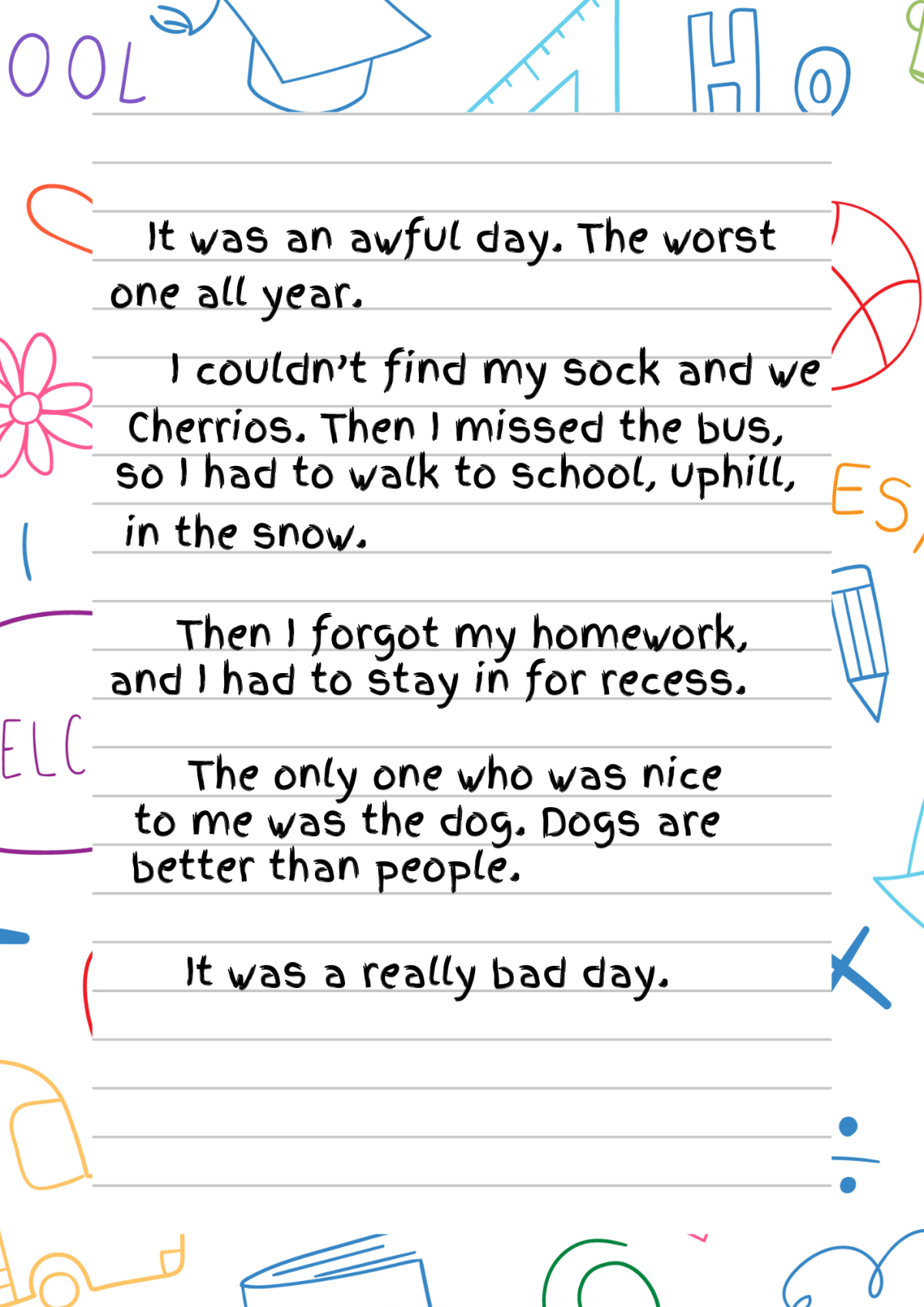
Learn from my mistakes, forget what Mr. Mountain said, and pay attention to how you start an essay, a story, even a blog post – don’t give away all the goods in the first sentence. Give your reader a reason to keep reading. Don’t start with – It was an awful day – and then go on to explain how it was awful. Just jump right in with sharing the story of your awful day.

The problem with starting with, It was an awful day is that you’ve done the work for your reader. And they don’t need (or want) you to do that for them. Once you tell them that your skirt got caught in the taxi door and it was ripped from your body when the cab pulled away or you describe the foul, icky mess next to the dog bed you stepped into in your bare feet that squeezed between your toes, they’ll figure it out.
Don’t make it so easy for the reader. Unless your reader is your fourth-grade teacher. Or you’re writing news for your local paper (does that happen anymore?). Or you’re leaving directions for your spouse on how to operate the television. Then, of course, go ahead and wow them with your five-paragraph essay abilities.
Otherwise, keep them guessing and hook your reader.

Hey, thanks for reading. I know you’ve got lots of options, so thanks for sharing a few of your minutes with me.
Honored,
Cara
If you’re a writer (or you wanna be) and you’d like some guidance, editing, accountability, or some good old fashioned encouragement in meeting your writing goals, reach out. I offer one-on-one coaching.
Curious about my fiction? My latest novel, Blind Turn is a mother-daughter story of forgiveness in the aftermath of a fatal texting and driving accident. Learn more about it and find out how to get your copy here.
If you want to know what else I’m up to, check out my website, CaraWrites.com.
If you’d like to subscribe to my twice monthly emails, click here.
And If you’re a dog lover, check out my other blog, Another Good Dog. And if you want to know what is really happening in the animal shelters in this country, visit, Who Will Let the Dogs Out.
I’d love to connect with you on Facebook or Instagram, and I’m thrilled to get email from readers (and writers), you can reach me at carasueachterberg@gmail.com.
100 Dogs & Counting: One Woman, Ten Thousand Miles, and a Journey Into the Heart of Shelters and Rescues is available anywhere books are sold, but if you’d like some help finding it (or want to read some lovely reviews), click here.


 My Life in Paragraphs
Love the way you write and I’ve been on this journey with you since about the beginning….well not Mr. Mountain’s class!
LikeLiked by 1 person
Thanks!!
LikeLike
Uhhhh… The five paragraph essay has a place. It is a foundation for clear thinking and it’s small and direct enough that a kid can evaluate it on his/her own. It’s a tangible target in a class that to most kids seems vague and “What does the teacher WANT anyway?” It isn’t even bad writing. Personally, I prefer it over the kind of discursive story-telling journalism that is in vogue now, but that’s me. The challenge is getting a student BEYOND the five paragraph essay when he/she is ready. It has no currency in fiction writing, as you say, but it can be a place for a writer to start a story. I think every writer learns to write every time they sit down to write. I see the five paragraph essay as a tool for helping people figure out what they have to say. HOW they end up saying it might NOT be a five paragraph essay. The best short story I’ve ever ready is one paragraph long.
LikeLiked by 1 person
All true. I shouldn’t bash it – but it’s such an easy target and such a hard habit to break!
LikeLiked by 1 person
I kind of think of it in baseball terms. You get to first base, OK, then second, Yay! But then? When is a hit enough to carry you the whole way? It’s risky at that point. Teaching business communication I had to break my students of two habits — using fancy words and the five paragraph essay. Some of them REALLY believed I was trying to make them fail by have them revise a five paragraph good news message into one and to eschew the plethora of pedantic verbage they’d picked up.
LikeLike