AI and Me (and You)

You may (or may not) have noticed that I’ve refrained from commenting or posting or engaging in discussion of AI. Initially, I just thanked my lucky stars that my kids are already grown and out of school, but secretly I really hoped this was a fad and it would go away.

It hasn’t.

Continue reading “AI and Me (and You)”

Dialogue with Anne Lamott (and me)

Now, I think I love Anne Lamott more than the average bear. I’ve read everything she’s written, stalk her a bit on Facebook, even listen to the sermons she’s given at random churches throughout the years. But…

Here’s the thing. We teach best what we most need to learn. As a mediocre rider, I learned A LOT teaching riding. As a passionate, but unstructured, often too-wordy writer and struggling, lazy marketer, I am good at teaching writers to write and publish. Because I’ve had to work so hard for it. When something doesn’t come naturally, you have to pick it to pieces to figure it out. If you’re a natural, well, how do you teach that?

Anne Lamott, while a wonderful teacher in many ways, is not the best at teaching dialogue. Why? Because she is a master at writing it. How many times have you read her work and felt like she was talking to you from across the booth at your favorite coffee shop. Or thought, ‘she totally gets it.’ (If you don’t believe me, read Operating Instructions.)

This very short chapter on dialogue is pretty vague with lots of ideas but nothing truly concrete beyond listen to your characters well so that you can make them speak authentically.

She also advises listening to people everywhere in your life and remembering cadences, tones, turns of phrase.

Unless you’re walking around with the recording app going on your phone. Which seems brilliant until you realize you will never actually listen to all that dribble and ums and mundane conversation about the weather and how ‘totally fine’ you and everyone you run into are doing (when in reality you are struggling to make it to lunch time and the freedom to play Match 3 unencumbered on your phone, which will be dead by then because of all that recording).

And, for the most part, we don’t remember the words people say. Instead, we remember the feeling we got from those words.

Another brilliant writer, Maya Angelou, said it best when she said people will not remember what you do, but they will remember how you made them feel.

I’m not saying that reading the chapter on dialogue won’t teach you something. Everything you read teaches you something.

Instead, I’m going to offer you a mini-version of the class I teach on dialogue.

  • Dialogue is the best way to reveal characters.
  • Use characters’ names sparingly. We don’t say each other’s names very often in real life. Using a person’s name every other line is awkward (try this in real life).
  • Use only dialogue tags that are necessary and use primarily “said.” Avoid adverbs at all cost! (if you have to describe how someone said something, then re-think what they are saying. Not to beat a dead horse, but show, don’t tell.)
  • Read it outloud. If you really want to hear it, read it outloud with someone else. (You can also try using the voice on your computer to read it to you.)
  • Don’t use dialogue to dump information. (That’s lazy writing.) No soliloquys. People don’t talk like that, and if they did they would have no friends.
  • You don’t need all the hellos and good byes, or the small talk of real life, it’s boring and drags down the dialogue.
  • Characters generally sound better and think faster than we do. Be clever and funny, whenever possible.
  • Punctuate correctly – learn this. Doing it wrong is a giveaway that you are an amateur. There are lots of resources for this – study them.
  • You don’t have to give complete conversations. That’s too tedious for the reader. Jump in mid-conversation and jump out before it’s completed.
  • People have distinct speech patterns, but they may be subtle. Kids sound different than adults. Educated sounds different than uneducated. Think about who your characters are – none should sound the same. In fact, once we know our characters we should be able to tell who is talking by the way they talk.
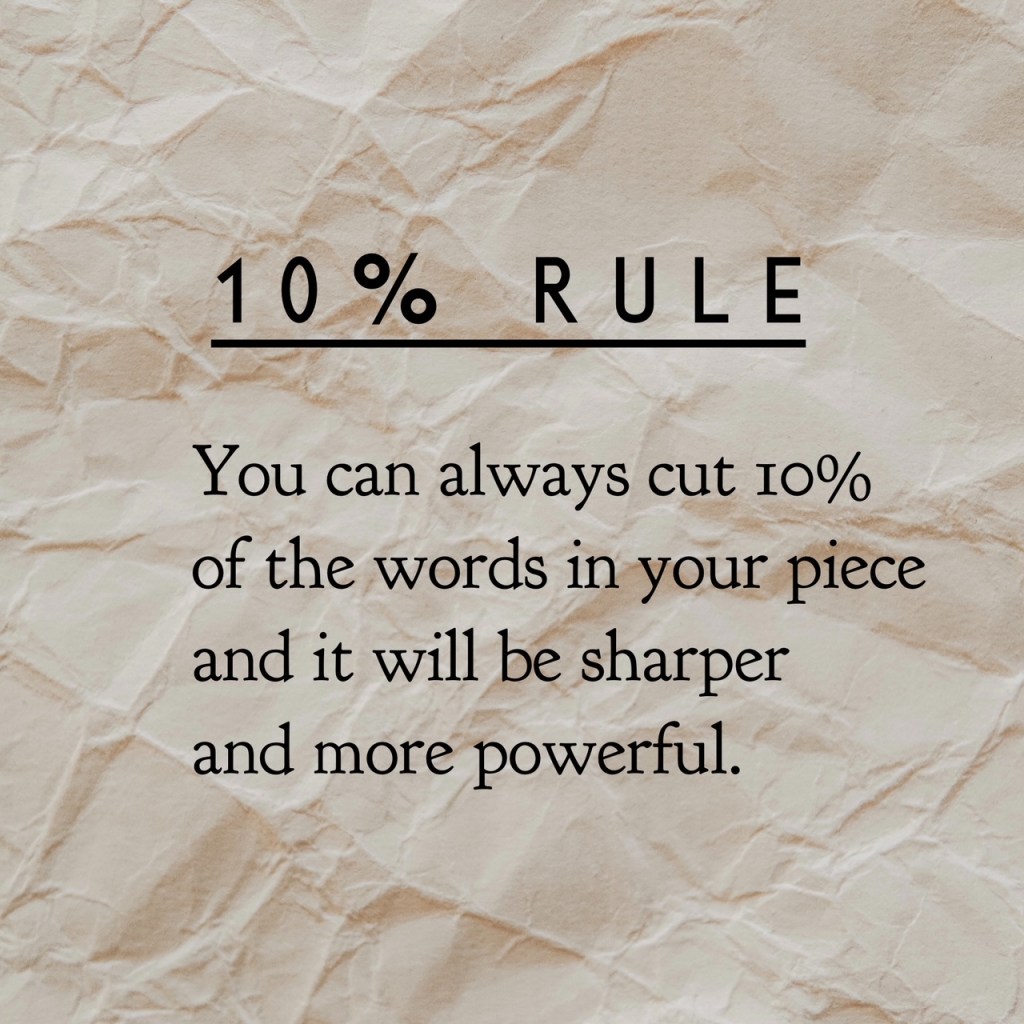
  • My personal golden rule: Characters don’t waste words. If it doesn’t move the story forward or reveal character, cut it out.

I usually teach that in about 90 minutes with lots of examples and exercises, so if any of it doesn’t make sense, please raise your hand. I’m happy to expound on any of it.

Hey, thanks for reading. I know you’ve got lots of options, so thanks for sharing a few of your minutes with me.

Honored,

Cara

If you’re curious about what else I’m up to, check out my website, CaraWrites.com.

If you’d like to subscribe to my twice monthly emails, click here.

If you’re a dog lover, check out my other blog, Another Good Dog. And if you want to know what is really happening in the animal shelters in this country, visit, Who Will Let the Dogs Out, and subscribe to the blog/newsletter I write there. You can also support us, but signing up to bid in our fall online auction.

I’d love to connect with you on Facebook or Instagram, and I’m thrilled to get email from readers (and writers), you can reach me at carasueachterberg@gmail.com.

My latest novel, Blind Turn is a mother-daughter story of forgiveness in the aftermath of a fatal texting and driving accident. It won the Womens Fiction category of the American Writing Awards in 2022. Learn more about it and find out how to get your copy here.

My most recent memoir, 100 Dogs & Counting: One Woman, Ten Thousand Miles, and a Journey Into the Heart of Shelters and Rescues is available anywhere books are sold, but if you’d like some help finding it (or want to read some lovely reviews), click here.

Book Club: School Lunches and Polaroids

I remember the School Lunch chapter from the very first time I read this book. I didn’t get it. Maybe I still don’t. Lamott says school lunches are full of the same longings and dynamics and anxieties for everyone, even if the school setting is different.

Well, maybe it’s an East Coast/West Coast thing, but the experiences she writes about – what was acceptable (bologna, pb&J) mattered and you were ostracized for bringing smelly, wrong things (which often happened if your father made your sandwich)—those didn’t bring any sense of recognition for me. I remember basically zero about elementary school lunch period.

Continue reading “Book Club: School Lunches and Polaroids”

My personal book club (Meeting 2) and a FREE book just for you!

Welcome back to my personal book club. (don’t worry I’ll tell you about your free book in a moment)

Because the chapters are so short, for this next book club gathering, I’ve covered the first three chapters of Bird by Bird by Anne Lamott.

Continue reading “My personal book club (Meeting 2) and a FREE book just for you!”

My Latest Editing Discovery

I just discovered something amazing! It’s changed my life – okay—just my editing habits.

Did you know that Microsoft Word has a ‘read aloud’ feature? You can click on it and a voice reads your work to you. It’s an amazing way to spot silly typos, but also really helps when it comes to writing dialogue. There’s no going back.

One added bonus is that my foster dog Marley, who is prone to overreacting at anything she hears outside, and tends to whine at me if I’m still for too long. (“You don’t seem to be doing anything hooman, so you could easily be petting me.”)

Continue reading “My Latest Editing Discovery”

Why the Five Paragraph Essay is Dead

I was a whiz at the five-paragraph essay in my day. It made so much sense.

Paragraph one: tell them what you’re going to tell them

Paragraphs two thru four: tell them

Paragraph five: tell them what you told them

At least that’s how it was explained to us by Mr. Mountain, the honors English teacher who let us play Trivial Pursuit on Fridays.

I could knock out an A+ five-paragraph essay after 48 hours with no sleep and WAY too much alcohol (I proved that fact in college composition class more often than I’d care to admit).

But here’s the thing about five-paragraph essays: That’s not how to write fiction, or anything anymore (unless you’re in fourth grade and taking a standardized test).

Continue reading “Why the Five Paragraph Essay is Dead”

Give the Reader a Little Credit

“Assume they are wearing pants.”

pants

I’m not certain which famous author wrote that in an article I read in which rich and well-known writers were asked for their best piece of writing advice.

I’m also not certain how many times I’ve quoted it to creative writing students. It used to hang on a little sticky note on my computer monitor, but it’s probably lost amongst the dust bunnies behind my desk now, the sticky long since dried up.

I’m a wordy writer. If it weren’t for the countless editors who forced me to bend to their word count will, I probably never would have been published. I tend to over-tell you what’s happening, repeat myself, as it were.

When you’re writing a clever personal essay where voice is the most engaging feature, you can get away with extra words. But in fiction, readers have no patience for the writer who explains every turn of the doorknob and unfolding of a napkin.

‘Assume they are wearing pants’ means that there is much you can trust the reader to figure out on his or her own.

You don’t need to write that your character brushed his teeth or pulled on his pants or went to the potty or drove to work. You can trust your reader to figure out by the time your character ‘stepped out of the elevator on the sixth floor of the Bronson building ready to conquer the world or at least the part of the world that dealt with Fifteen-millimeter straws ’ that all of that has happened.

But maybe your character was late? You might need a few of those steps. ‘Fred brushed his teeth, as he drove, weaving in and out of his lane frustrated by the slowpoke in front of him mentally rehearsing his presentation which should have started ten minutes ago. In the elevator, he noticed his socks didn’t match and he had toothpaste on his tie.’

I still didn’t tell you that he put his pants on, but I’m pretty sure you know he’s wearing pants. Otherwise, everyone in the elevator would be staring at him, right?

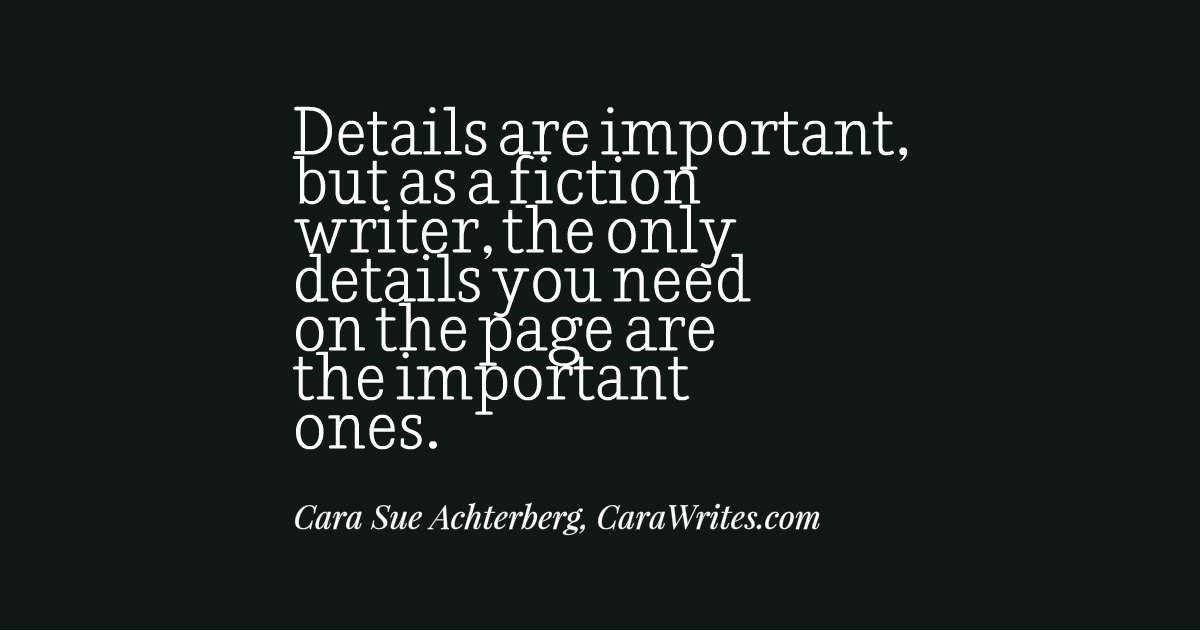
Details are important, but the only details you need to include are the important ones.

Hey, thanks for reading. I know you’ve got lots of options, so thanks for sharing a few of your minutes with me.

Honored,

Cara

If you’d like to know more about me, my books, and where you might run into me, check out my website, CaraWrites.com.

If you’d like to subscribe to my (sometimes) monthly e-newsletter, click here.

If you’re a dog lover, check out my other blog, Another Good Dog.

I’d love to connect with you on Facebook, twitter, or Instagram, and I’m thrilled to get email from readers (and writers), you can reach me at carasueachterberg@gmail.com.

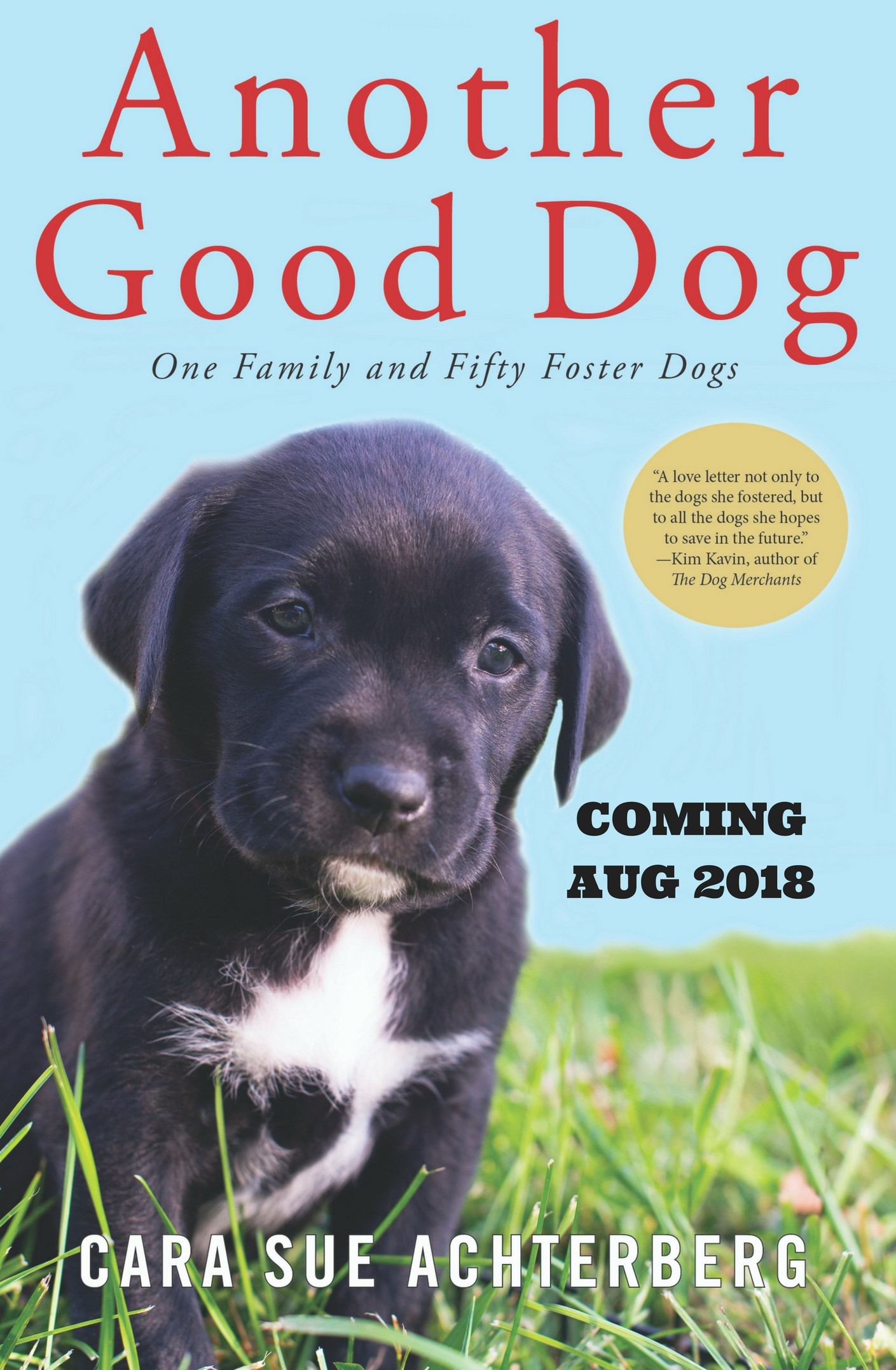
COMING AUGUST 7 2018 FROM Pegasus Books (available for preorder now:

Add subheading


Tighten up: Nine words that weaken you writing

Some words are weak. Plain and simple. These words not only water-down your writing but mark you as a lazy writer.

lazy writer 2

In the frenzy of a first draft, we toss in these words because there isn’t time to create the perfect metaphor. The story is flying fast and furious and you just need to get the words on the page, darn it. You’ll come up with the right simile or example or label or description later. When you have time. (But who has time?)

Before you know it these words have crept in and claimed their spot like the extra pounds you put on every winter. The rest of the story is so stellar, what’s an occasional weak word?

Editing makes or breaks a piece of writing. Truth.

Search out these words and replace them with more powerful words—words that help the reader see, sense, taste, touch, smell, hear what you’re trying to say. Words that create a clear picture or definite emotion. Strong words.

So what are these words that clutter up your writing?

I’ve listed nine, but there are others. A few adverbs come to mind. Personally, I love adverbs, so I’m not taking shots at them here. The words I’m going after are worse than a clever adverb. These are words that undermine the structure of your prose. Fire up that find feature and I bet you’ll spot your personal favorites in minutes.

Thing. What is it? Animal, vegetable, mineral? Could be. Thing is the vaguest of words out there. Don’t be a lazy writer—name it.

Stuff. Another horribly weak word. What does it mean? Could be anything. Stuff leaves way too much to the imagination. Be specific.

Seem. This is one of my pet words. Seem lets you hedge your bets. It only seems that way, so don’t blame me, I could be wrong. Seem dilutes the power of the word it precedes, and powerful words are so much more interesting to the reader. Go for broke. Either it is or it isn’t, and if you’re convinced it’s somewhere in between, describe why instead of taking the cheater’s route.

That. This one is tough for most of us but read your sentence with the word and without it. If you can cut it, then do.

With: I knew that she would stop by at five.

Without: I knew she would stop by at five.

Felt.  Unless we’re talking about that fuzzy material you used for craft projects in elementary school, avoid this word. If you’re telling the reader how the character felt, you’re not showing them. Find another way.

Cheating: She felt like he hated her.

Not that great, but better: His eyes grew dark as they met hers; it sent a shiver down her spine.

Think/Thought. When writing a character’s thoughts, you can almost always drop the intro. In general, most observations are attributed to your narrator. So unless you’re writing in third person omniscient (and you really shouldn’t), you don’t need to tell the reader the thoughts belong to the character, you can show them by the way you say it or by using italics. Either way, you take out the clunky he thought that slows down the story.

She thought it would take an elephant to move that box.

It would take an elephant to move that box.

The door opened and she thought she saw the woman from the night before sitting at the bar.

The door opened. The woman from the night before sat at the bar.

Walked. Sure it’s fine. We all walk, but how boring is that when a character can strut, stumble, amble, or stroll? Don’t miss an opportunity to say so much with just one word. You cheat yourself when your characters simply walk.

Geraldine walked up the sidewalk.

Geraldine marched up the sidewalk.

Kind of or Sort of. Once again, make a decision. Either it is or it isn’t. I’ve been guilty of using both these phrases, but when I’ve done it, it’s because that’s the way the character speaks. If you aren’t writing as a teenager or timid person than cut them out.

Then. Okay, maybe there’s a time and place for then, but it’s intrinsically weak. It sounds weak. It sounds like a second grader writing their first essay. The cat ran in, then the dog did. Then the mouse did. Then I did….You can do better. You can write better.

None of these nine words/phrases are inherently evil, but if your writing is littered with them, you may want to take a closer look. Weak words water down your writing. They make your prose vague and wishy-washy.  Mealy-mouthed, even. And you wouldn’t want to be mealy-mouthed now would you?

Then people might think that your stuff seems kind of amateur, and that sort of thing can make you feel like walking away from it all.

Hey, thanks for reading. I know you’ve got lots of options, so thanks for sharing a few of your minutes with me.

Honored,

Cara

If you’d like to know more about me, my books, and where you might run into me, check out my website, CaraWrites.com.

If you’d like to subscribe to my (sometimes) monthly e-newsletter, click here.

If you’re a dog lover, check out my other blog, Another Good Dog.

I’d love to connect with you on Facebook, twitter, or Instagram, and I’m thrilled to get email from readers (and writers), you can reach me at carasueachterberg@gmail.com.

COMING AUGUST 2018 FROM Pegasus Books (available for preorder now:
Add subheading


Just Found My Suspenders

I am hard at work on yet another re-write of a manuscript that I have been working on now for almost eight years.

Enough already.

You would think, wouldn’t you?

And yet I can’t give up.

When my agent tossed the latest re-write back at me insisting it needed yet another overhaul, I was crushed. Continue reading “Just Found My Suspenders”